Flag Day June 14th, 2023
Talking Tombstones – aftermath.
We got to our posts around 5:00 pm. It took a while to get the uniform straight and I am not sure if it ever was on properly.
The event was fun. At rehearsal, we were told that we would share our stories perhaps 5 times at a max. I would hazard a guess that I spoke 50 times. The crowd was terrific. The event was fun and educational. The cause – the reason we did this was important as well.
My wife Linda helped at the gate and importantly, helped with a water ration to us all. That was appreciated.
I am glad the Bartholomew Historical Society involved us in this project.

Peter Dieterlen – as Private Franklin J. Pancake
Fred Leickly – as Major Augustus H. Abbett
Phil McClure – representing the unknown soldier at the GAR memorial
Terry Furgason – as Major Simeon S. Stansifer
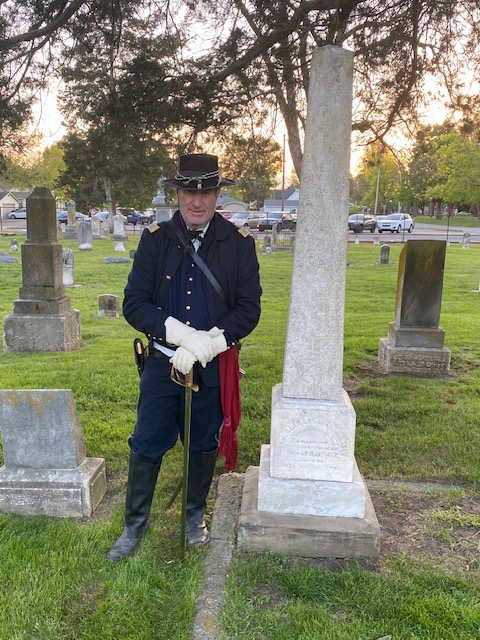
Standing by the memorial to Major Augustus H. Abbett.
Talking Tombstones
Bartholomew County Historical Society – Fund Raiser
On Thursday May 4rth 5:30-8:00 at the Columbus City Cemetery – TALKING TOMBSTONES 2023.
Actors, reenactors and history buffs will, for a few hours, bring back to life some of the famous people who are buried there. Tickets for the event can be purchased online, at the Historical Society, and at the gate.
As a Civil War reenactor and a member of the John B. Anderson Camp of the Sons of Union Veterans of the Civil War I and a few other camp members will be there for what the organizers describe as a night at the museum – education and enlightenment.
From our group
Pete Dieterlen – as Private Franklin J. Pancake of the Indiana 53rd volunteer infantry
Terry Furgason – Colonel Simeon S. Stansifer – Provost Indiana 120th volunteer infantry
Phil McClure – representing all unknown soldiers standing guard at the Grand Army of the Republic/Woman’s Relief Corp memorial
Jeff Maudlin – in uniform
Fred Leickly – Augustus H. Abbett, Major Indiana 67th volunteer infantry.
Major Augustus H. Abbett (October 16, 1831 – September 14, 1862)
What follows is my portrayal (first person script) of this Bartholomew County Hero. Rember, at this event Major Abbett comes to life for a few hours to tell visitors about his short life. This would be all first person.
My parents were John and Margaret Abbett. John Abbett came from Kentucky on horseback to Bartholomew County in 1828. He was a tailor and later became a preacher at the Azalia church. My mother was Margaret Hinkson Abbett. She was the sister of an Ohio supreme court judge. Mother ran the first ever boarding house in this city.
I had 8 siblings.
Melinda
Austin – Died at age 3.
Louisa – Died at age 7.
Origin
Joseph – Died at age 1 month.
Melissa – Died at age 8.
John
Emma
John died in 1862 from an illness he acquired while serving as aide-de-camp for my unit. He brought home this illness which took Origin from the family.
Only Melinda (Siddall) and Emma (Crane) go on to live long lives.
All of my siblings and parents are here with me in the Columbus City Cemetery.
I married Kate A. Luker in 1862. We did not have enough time to have children.
I do not recall much of my life except for my service to my country.
I was first a captain in the Indiana 6th volunteer infantry. We were company B formed in Bartholomew County. We were 3-month soldiers, figuring we would beat the rebels in a short time. That clearly did not happen as I had overheard visitors say as they stopped by to visit me.
Our first taste of war was in West Virginia- the battles of Phillippi, Laurel Mountain, Rich Mountain, and Carrick’s Ford.
The three months’ term of service had ended, and the regiment was headed home – July 23, 1862. We had heard about what was going on in the east and how the Union forces were being beaten. The regiment felt that if those around Washington City with ‘all the pomp and circumstance of glorious war’ had done as well as we had in the Three Month’s Campaign, things would have been otherwise. (From Andrew J Grayson, ‘The Spirit of 1861”). We mustered out on August 2, 1861.
The war still raged on. The Union needed troops. The Regiment was re-organized in Madison, Indiana for a three-year term of duty. I was made a Major in the newly reformed unit.
We were first sent to Louisville, Ky to respond to rumors that Morgan was planning to invade the state. We left Madison 500 strong, but poorly equipped. In October 1861 while at Nolin Creek, Ky we were joined by 300 additional recruits from Madison. We were made part of Rousseau’s brigade of McCook’s Division. We moved on to Bowling Green Ky, then on to Nashville then Savannah, Tn. There a steamer took us to Pittsburg Landing and we joined the fight at Shiloh on the second day. The arrival of our regiment and others helped save the day and gave the Union a victory at Shiloh
After that victory it was on to Corinth, Ms. When that job was finished, we then proceeded to Nashville with Buell’s army with Louisville, Ky as the goal. It was around this time that I resigned due to some troubles in the unit.
My firm sense of duty caused me to re-enter the service as a Major in the newly formed Indiana 67th Volunteer Infantry.
Let me take you to my last days and tell you about the Battle of Munfordville where I lost my life on this earth.
In the summer of 1862 General Braxton Bragg of the Confederacy invaded Kentucky with a large army of 16,000 men. I was part of the Union Garrison at Munfordville which was a suppyl depot for our army. It was a key position on the Louisville and Nashville railroad. We had about 4,000 soldiers in the garrison. It was a siege and battle lasting 3 days. The garrison was captured by Bragg’s overwhelming force. This battle set the scene for the Battle of Perryville October 8, 1862.
It all started when Confederate cavalry under the command of General E. Kirby Smith, approached the eastern fortifications and demanded an unconditional surrender. This was promptly refused by our Colonel John T. Wilder who commanded the Union forces.
My unit was defending Fort Craig- a 5-poined earthen star fort which guarding the eastern approaches to the area. That site saw some of the fiercest fighting during the battle. The Johnnies were Mississippi infantry – the 7th, 9th, and 29th along with a battalion of sharpshooters and artillery from Ketchum’s Brigade. Our position was attacked by this group on 3 sides. We held our ground and the enemy fled in great confusion. The Rebs had thought that we were a small force. But when the skirmishers were pushed back, they realized the strength of the Union position.
As Union troops were brought into position, Colonel Wilder burned a church- this made the Confederate commanders believe that the Union was retreating. With this, the forts were attacked in earnest.
As the attack began again, our boys and two cannons could not hold them back. I charged to the ramparts of the fort, not caring about my own safety, but to rally the men who had never seen the ‘elephant’. With sword in one hand and my hat in the other I raised myself up, stood as an inspiration to my men, to urge them forward when suddenly a volley of shot caught me. I was shot in the heart and died on that spot. As I rest here for my eternity, I overheard someone say that in that volley, our Union Flag had 146 holes in it from Confederate guns.
Despite the gallant effort by the boys, after two more days of fighting, the fort was surrendered to the overwhelming army of General Bragg. My body was transported home to Columbus, Indiana and here I lay in the Columbus City Cemetery.
It has been said of me – “Among the names of Bartholomew County soldiers conspicuous for military service, none deserves more prominent mention than that of Augustus H. Abbett. In less than a week after the firing at Fort Sumter, he, at the head of 100 men, was ready to go to the front in defense of his country. After serving less than a month, he was promoted Major of the Regiment, September 5, 1862. At the Battle of Munfordville, Ky the first action in which the regiment was engaged, taking an exposed position in order to encourage his men, he was killed on September 14th, 1862.
My father John came to Bartholomew
 Leickly Stories